How to Care for Your Trees in the Intense Summer Heat
Summer in our part of the world is a welcome reprieve from the frigid temperatures...
READ MORE
Say hello to beautiful trees. Tell us your location to get the best tree care services for your area!

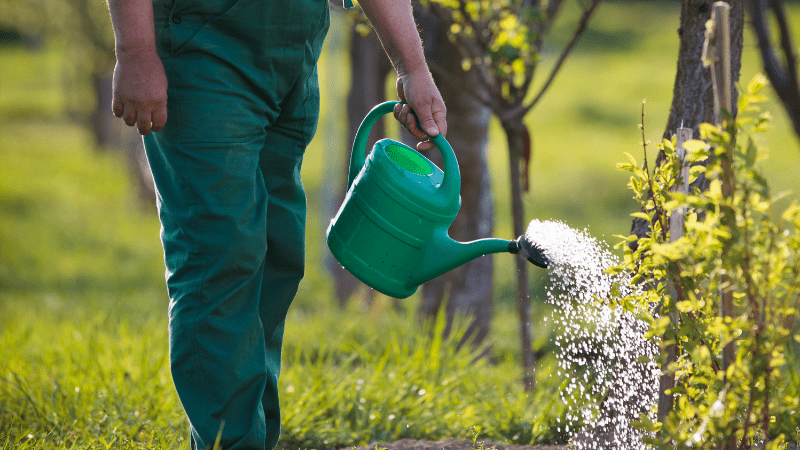
At Green Drop, we see it every season: a homeowner invests in a beautiful, high-quality specimen, digs the perfect hole, and adds the best mulch—only to watch the tree decline by July. When we come out to diagnose the issue, the culprit is almost never pests or disease. It is almost always a misunderstanding of proper watering.
For a newly planted tree, water is more than just hydration; it is the fuel for structural survival. The first three years of a tree’s life are a race against time to establish a root system capable of sustaining it for a century. If you get the watering wrong, you aren’t just wilting leaves—you are breaking the tree’s physiological foundation.
In many of the regions we service, we aren’t dealing with loamy, well-draining garden soil. We are dealing with heavy clay. Clay is a double-edged sword for tree health. It holds nutrients and water exceptionally well, but its tiny particle size means it drains slowly and lacks air pockets.
The “death spiral” for trees in clay soil often looks like this:
| Symptom | Underwatering | Overwatering |
|---|---|---|
| Leaf Appearance | Brittle, brown edges, curling | Soft, yellowing, or “droopy” green |
| Soil Feel | Cracked, hard, dusty | Mucky, foul-smelling, saturated |
| New Growth | Stunted or nonexistent | Wilting despite wet soil |
One of the most common mistakes we see as arborists is the “sprinkler strategy.” Homeowners often think that because their lawn sprinklers run every day, the tree is getting plenty of water.
This is a myth. Proper watering for a tree is about volume and depth, not frequency.
Daily light watering only saturates the top inch or two of soil. This encourages the tree to grow shallow, weak roots near the surface. When a heatwave hits or the irrigation fails for two days, those shallow roots fry.
The Arborist’s Secret: You want to mimic a slow, soaking rain. By applying water slowly over several hours, you allow the moisture to penetrate 12–18 inches deep. This coaxes the roots to grow downward, where the soil stays cooler and moister, creating a “drought-proof” tree.
When you plant a tree, you are essentially performing a transplant surgery. The tree has lost up to 90% of its root system during the digging process at the nursery. It is in a state of “transplant shock.”
Here is how your watering strategy should evolve over the first three years:
Year 1: The Survival Phase
The tree is entirely dependent on you. Its roots are confined to the original nursery root ball. You must apply water directly to that root ball and the immediate surrounding soil. If the root ball dries out, the tree has no way to “reach” for water elsewhere.
Year 2: The Expansion Phase
The roots are beginning to “bridge” the gap between the planting hole and the native soil. You should start watering a wider area—extending about 12 inches beyond the drip line (the edge of the leaves). This encourages the roots to push outward.
Year 3: The Hardening Phase
By year three, the tree is becoming established. You can begin to reduce the frequency of watering, but maintain the high volume. You are training the tree to rely on the deeper moisture reserves in the earth.
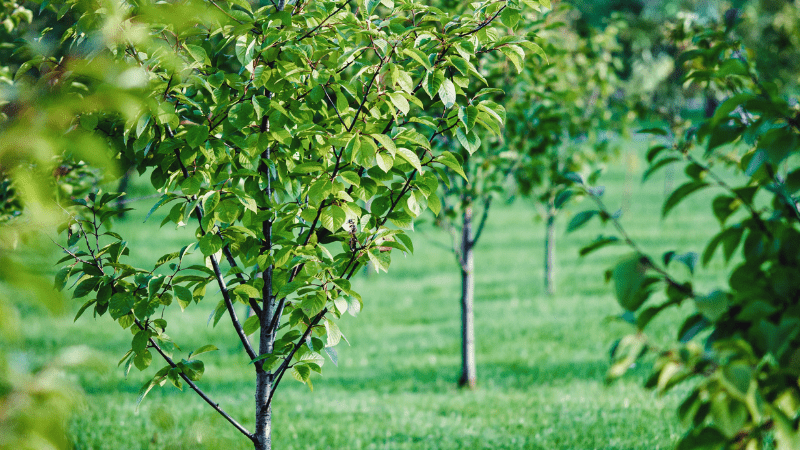
If you’ve walked through a city park or a new subdivision lately, you’ve likely seen green “donuts” or upright bags zipped around the base of young trees. These are irrigation bags (often called Gator bags), and they are one of the best inventions in modern arboriculture.
In municipal or high-traffic contexts, these bags solve three major problems:
For homeowners with busy schedules, an irrigation bag is the easiest way to ensure proper watering without having to babysit the garden.
Trees are communicative, but they speak a slow language. By the time a tree looks “dead,” it has usually been suffering for weeks. To save your investment, you must learn to monitor for early drought stress.
Before a leaf turns brown, it loses its turgor pressure (the internal water pressure that keeps it upright). If the leaves look “tired” or are drooping in the late afternoon but don’t perk up by the next morning, the tree is thirsty.
If your Maple is turning brilliant red in mid-August, don’t celebrate the early autumn. This is a stress response. The tree is shutting down its chlorophyll production to save energy because it doesn’t have enough water to maintain its leaves.
Look for browning along the outer edges of the leaves while the veins stay green. This “scorch” happens because the tree cannot transport water to the very tips of its extremities fast enough to keep up with evaporation.
Don’t guess—check. Stick your finger 2–3 inches into the soil. If it feels dry and crumbly, water. If it feels like a wrung-out sponge, you’re in the sweet spot. If it’s muddy, back off.
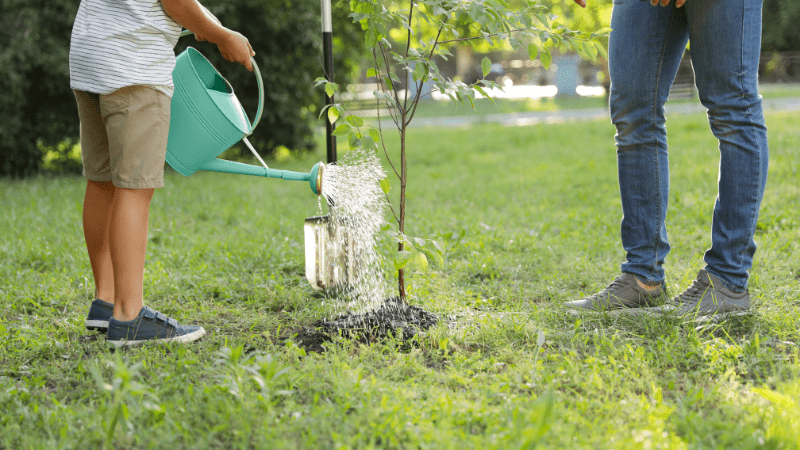
At Green Drop, we believe that every tree planted is a legacy. But that legacy depends entirely on the hydration it receives in those first 36 months. By understanding the unique challenges of your soil, choosing slow-release methods over high-pressure sprays, and watching for the subtle signs of stress, you ensure your tree doesn’t just survive—it thrives.
Remember: A tree that is watered properly in its youth develops a root system that can withstand the droughts of the future. Don’t let your investment go thirsty.
Need professional advice on your new trees? Contact Green Drop today for an arborist consultation. We’ll help you keep your canopy green and your roots deep.


