How to Care for Your Trees in the Intense Summer Heat
Summer in our part of the world is a welcome reprieve from the frigid temperatures...
READ MORE
Say hello to beautiful trees. Tell us your location to get the best tree care services for your area!

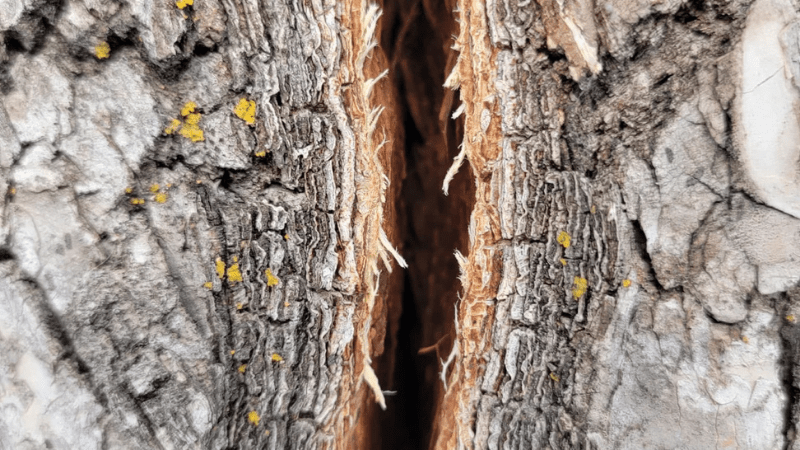
As ISA-Certified Arborists, we know that winter on the Prairies can be harsh, and not just for us! Rapid temperature swings and deep freezes are a defining characteristic of our climate, and they pose a unique threat to your yard’s greatest assets: your trees. One of the most common signs of winter stress is the sight of frost cracks, long vertical splits that can appear suddenly on a tree’s trunk. While alarming, understanding why they happen is the first step in successful winter tree care.
Frost cracks are long vertical splits that appear on tree trunks during winter due to rapid temperature swings. Often heard as a sharp, sudden cracking sound on a cold night, these splits typically run down the side of the trunk and can sometimes be several feet long. They are a direct result of physics—specifically, the expansion and contraction of wood under extreme temperature differences.
A frost crack is not just random damage; it’s a specific process caused by the difference in temperature between the inner and outer layers of the tree, especially when sunshine is involved.
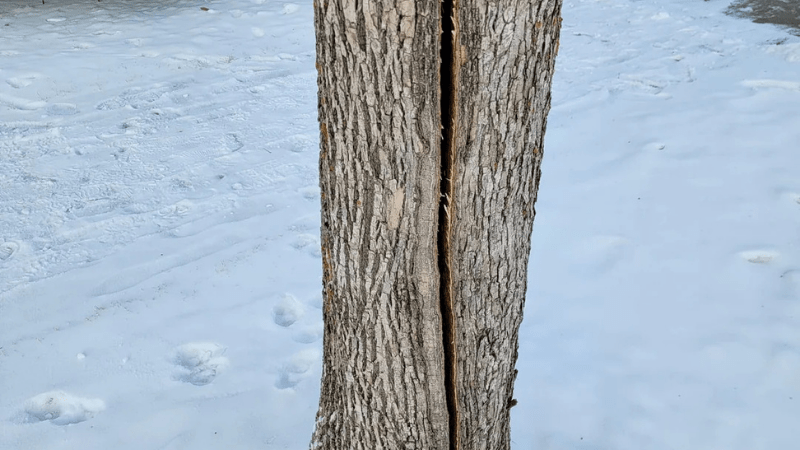
While any tree can be susceptible to frost cracking, certain species with thinner bark, faster growth rates, or previous injury are more prone to this winter injury.
Young trees with smooth bark are also particularly vulnerable, as their protective layer is not as thick or developed as mature specimens.
Identifying a frost crack is usually straightforward, but sometimes the signs can be subtle. Keep an eye out for:
The good news is that most trees are incredibly resilient. Frost cracks are often survivable, and a healthy tree will immediately begin forming a protective layer of callous wood to seal the wound.
However, the injury is not without risk. These cracks may reopen yearly at the same weak point, causing repeated damage. More importantly, an open crack creates a direct entry point for fungal spores, pests, and bacteria, which can allow decay to take hold in the heartwood or compromise stability over many years. A professional assessment is always recommended for large, deep, or repeated cracks.
Taking proactive steps in the late fall and early winter can significantly reduce the risk of frost cracking in your valuable trees.
With some areas of Canada experiencing colder temperatures than typical or with large fluctuations in temperature, frost cracks or “exploding trees” has become a hot topic. Simon Peacock from Green Drop Trees in Winnipeg commented within this CBC article.
By understanding the mechanics of a frost crack and implementing these simple preventative measures, you can ensure your trees are ready to face the deepest freeze and thaw cycles the season has to offer. To talk to a Green Drop Trees arborist about your specific issues, contact us.


